Historical & Religious Significanc:
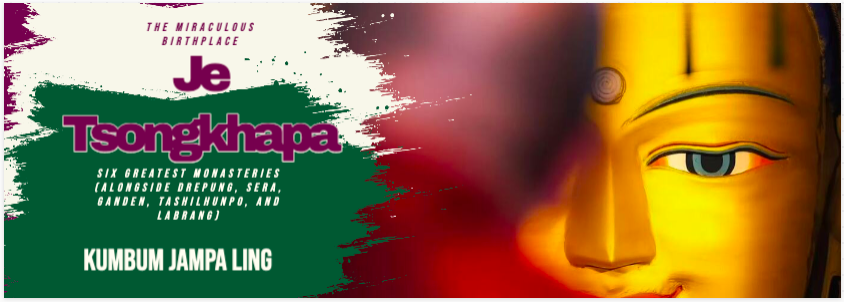
The Miraculous Birthplace: The monastery’s origin is not a founding date, but a birth. In 1357, the great master Je Tsongkhapa was born here. According to sacred texts, after his birth, his mother buried the placenta and umbilical cord. From this spot, a sandalwood tree miraculously grew. Its bark and leaves were said to bear natural impressions of the Sanskrit syllable “A” and images of the Buddha Simhanada (Lion’s Roar). This “Tree of Great Merit” (ཤིང་ཏོག་ཡོན་ཏན་ཆེན་པོ) is the literal and spiritual root of Kumbum. The name means “100,000 Images” (སྐུ་body + འབུམ་100,000), referring to these holy images.
From Sacred Site to Monastery: For nearly 200 years, the site was marked by a small stupa built around the tree by Tsongkhapa’s disciples. The full-scale monastery was initiated in 1560 by a local Tibetan Buddhist leader and formally established in 1583 by the 3rd Dalai Lama, Sonam Gyatso, on his way to Mongolia. He consecrated it and named it “Kumbum Jampa Ling” (Monastery of the Hundred Thousand Images of Maitreya).
A Gelug Powerhouse: As the birthplace of the Gelug school’s founder, Kumbum became one of its six greatest monasteries (alongside Drepung, Sera, Ganden, Tashilhunpo, and Labrang). It was a supreme center of learning, attracting monks from all over Tibet and Mongolia. The 7th Dalai Lama made significant expansions in the 18th century.
Architectural & Artistic Deep Dive
The monastery is not one building but a small monastic city of over 30 temples and halls, housing over 600 monks. It uniquely blends Han Chinese and Tibetan architectural styles.
Key Structures in Detail:
The Great Golden Tiled Hall (Ser Trang):
Core Relic: Built directly over the sacred sandalwood tree. The tree is encased within a magnificent silver stupa adorned with semi-precious stones, which is then enclosed within a larger, gold-gilded stupa.
The Roof: The name is literal. Its sloping roof is tiled with solid gold plates (donated by the Mongolian prince Gushri Khan and later the Qing Emperor Kangxi), weighing approximately 130 kg. The central gable is crowned with a golden Dharma wheel flanked by two golden deer.
The Great Hall of Meditation (Tsogchen Du Khang):
Function: The main assembly hall for prayer and ceremonies.
Capacity: Can seat over 2,000 monks.
Interior: Filled with rows of red pillars and hanging golden silk thangkas. The throne at the front is reserved for the Dalai Lama. The walls are lined with frescoes depicting Buddhist cosmology and the life of Tsongkhapa. The air is thick with the scent of yak butter lamps.
The Yak Butter Sculpture Hall:
Art Form: These are not simple figurines. They are intricate, large-scale narrative tableaux made from dyed yak butter mixed with minerals.
Process: Created in freezing conditions by specially trained monks. The themes change annually, often illustrating Jataka tales or complex mandalas. The Butter Lamp Festival showcases the year’s masterpieces.
The Eight Stupas (White Pagodas):
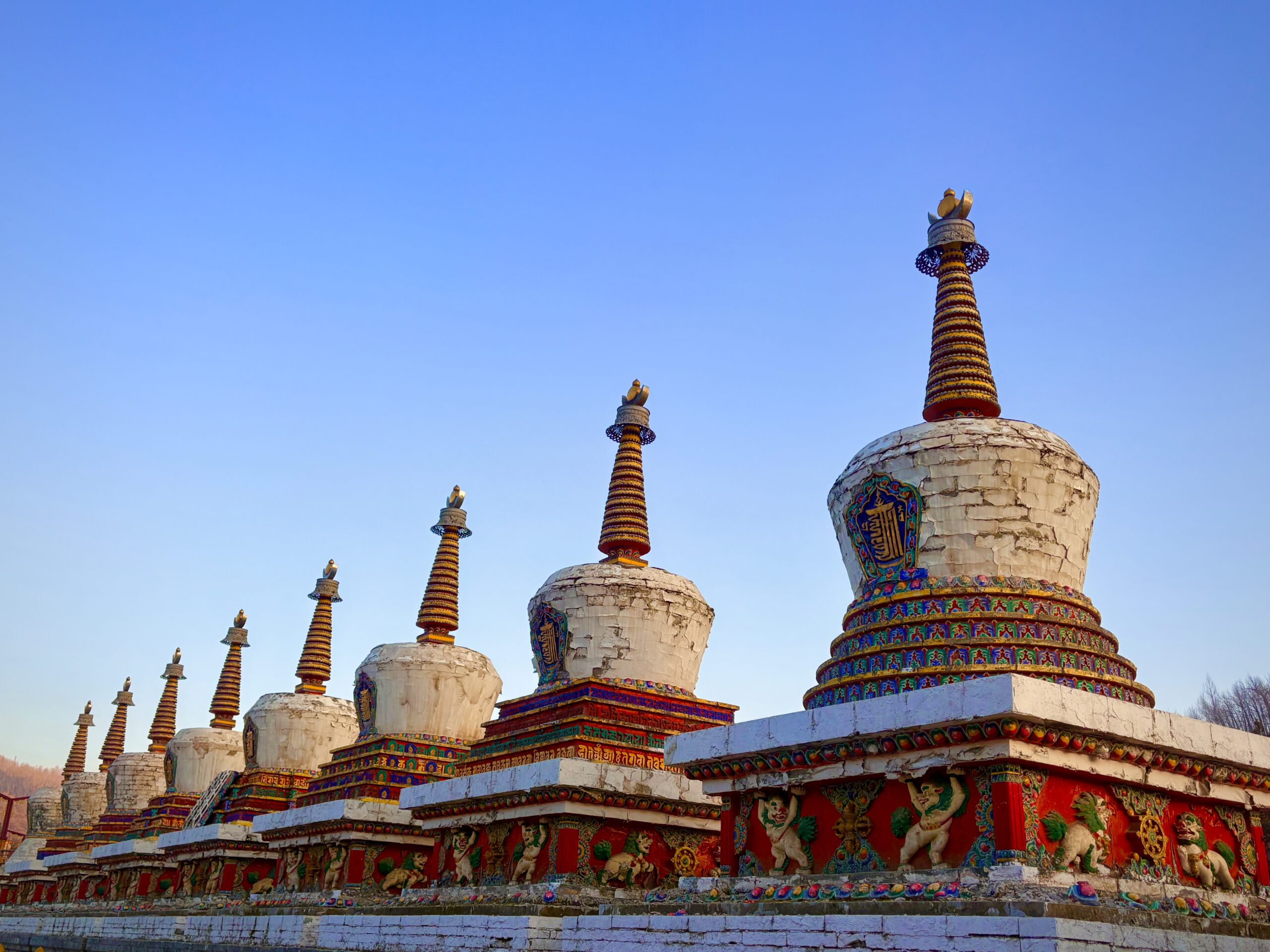
Located just inside the main gate, these eight identical white stupas in a row commemorate eight major deeds of the Buddha Shakyamuni (birth, enlightenment, first teaching, miracles, etc.). Pilgrims circumambulate them in a clockwise direction.
The Scripture Printing House:
Houses thousands of woodblock printing plates for sacred texts. You can sometimes witness monks printing prayers using traditional methods.
The Monk Debate: A Living Philosophy
Location: The open courtyard in front of the Great Hall of Meditation.
Time: Usually 2:00 PM to 4:00 PM on most afternoons (except special prayer days).
The Ritual: This is a formal pedagogical tool. The defender sits calmly, while the questioner stands, posing complex philosophical points from Buddhist logic and metaphysics.
Each point is punctuated by a dramatic clap of the hands (symbolizing the closing of one door of ignorance and opening another to wisdom) and a stamping foot (pushing forward the wheel of Dharma).
The atmosphere is intense, intellectual, and utterly captivating. Observe respectfully from the periphery.
Getting There from Xining:
Public Bus: Take Bus 909 from the “Xining Bus Station” (next to the main train station). Fare: ~¥5. Runs frequently, takes ~1 hour. Drops you at the parking lot, a 5-min walk to the gate.
Private Taxi: 45-minute drive. Negotiate a round-trip fare with waiting time (approx. ¥250-300 total). More flexible.
Ticket & Inside Navigation:
Ticket Booth: Clear signage. Ticket: ¥70. Optional electric cart between far-flung halls (~¥20).
Hire a Guide (Highly Recommended): Official guides (¥150-200 per group) at the entrance provide invaluable context about the symbolism, rituals, and history. Without one, you’ll see beautiful buildings but miss the profound meaning.
Pilgrim’s Path vs. Tourist Path:
Follow the pilgrims. They walk a clockwise kora (circumambulation) around the entire monastery complex, often spinning the giant prayer wheels in the long covered corridor. This outer kora offers beautiful views and a sense of scale.
What to Wear & Bring:
Modest clothing is mandatory: Covered shoulders, chest, and knees (for all genders).
Sturdy, comfortable shoes: Extensive walking on stone paths.
Sun protection & water: High altitude sun is strong.
Cash (small bills): For donations, buying prayer scarves (khatas), or small souvenirs from monk-run stalls.
Festival Dates (Based on Lunar Calendar):
Monlam Chenmo (Great Prayer Festival): 4th-25th of the 1st Tibetan month. The most important event, with massive sutra recitations and unveiling of a giant thangka.
Butter Lamp Festival: 15th of the 1st month, marking Buddha’s Miracle Day. The butter sculptures are displayed at night, illuminated by countless lamps.
Respectful Conduct:
Photography: STRICTLY FORBIDDEN inside most temple halls. Signs are posted. Allowed in outdoor courtyards. Never photograph a monk without explicit permission.
Movement: Always walk clockwise around stupas, altars, and inside temples when possible.